


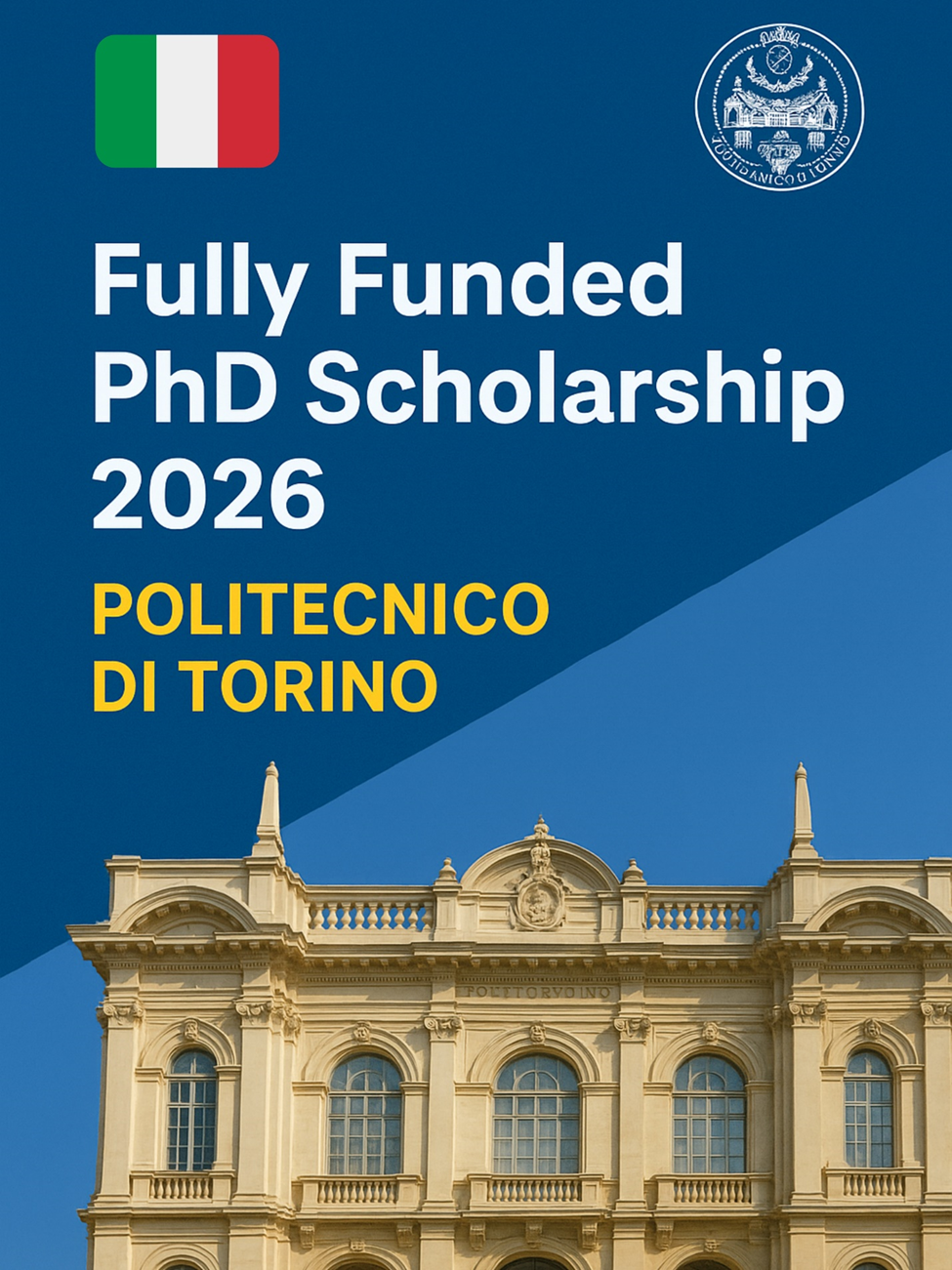
Politecnico di Torino is a leading technical university in Italy that regularly awards fully funded PhD positions across engineering, architecture and applied sciences. The university runs competitive calls (cycles) each year offering many scholarships—each covers a doctoral stipend plus research-related support.
This article gives a clear, SEO-friendly, step-by-step guide for international students: what to prepare, how to apply, how selection works, and practical tips to maximise your chances.
Quick facts (at a glance)
| Item | Detail |
| University | Politecnico di Torino |
| Level | PhD (Doctoral) — 41st cycle / 2026 intake (example cycle) |
| Minimum scholarships | Typically dozens per cycle (example: 96 in recent cycle) |
| Scholarship amount | Example gross annual ≈ €18,854.52 (check current Call) |
| Where to apply | Online via Apply@polito platform |
| Typical start dates | Session 1: Nov (example); Session 2: March (example) |
| Application portal | Politecnico di Torino — PhD Call page |
Note: the exact number of positions, stipend amount and dates vary by cycle. Always read the official Call (bandi) for the year you apply.
What the PhD scholarship covers (benefits)
Annual scholarship (tax & social rules apply): fixed gross amount for the academic year (see Call for precise year-by-year figure).
Research/travel allowance: support for conference attendance and international research stays (conditions in Call).
Company-cofunded options: some positions are co-funded by industry with special contractual terms and benefits.
Full-time supervision and access to labs: doctoral training, infrastructure and career development support.
Who can apply (eligibility summary)
Degree requirement: Master’s degree (or equivalent) completed before enrolment; Politecnico evaluates foreign qualifications.
Nationality: Open to applicants from any country (international applicants welcome).
Number of choices: Applicants can usually select up to two PhD programmes in one application (confirm in the Call).
Other rules: Specific reserved places, disability provisions, and incompatibility rules are listed in the Call.
PhD fields and programme types
Politecnico offers doctoral programmes across many specialisms, e.g.:
- Aerospace, Mechanical, Electrical & Electronic Engineering
- Civil & Environmental Engineering, Architectur
- Computer Science, Control & Automation
- Materials Science, Chemical Engineering, Physics
- Management, Production & Industrial Engineering
Positions are offered as: own-research topics, predefined project topics, or company-funded/apprenticeship positions.
Step-by-step application process
Follow these steps in order. Deadlines are strict—late or incomplete applications are not accepted.
1 Read the official Call carefully
Download and read the PhD Call for Applications from Politecnico’s website. It is the legal reference with programme lists, quotas, scoring rules and deadlines.
2 Choose programme(s) and session
Decide which PhD programme(s) and which session (e.g., November start or March start) suit your profile and research plan.
3 Prepare documents (2–6 weeks ahead)
Collect and digitise: passport, degree certificates, transcripts, curriculum vitae, publications, research proposal or statement of purpose, and referees’ contacts. Translate and legalise documents if required.
4 Register and complete the online form on Apply@polito
Create an account on Apply@polito, fill the application form, select programmes, upload documents in the prescribed formats and pay any application fees if applicable.
5 Submit before the deadline
Submit your application well before the posted deadline and save submission confirmations.
6 Await pre-selection and interview invitation
The Admissions Committee evaluates qualifications. Shortlisted candidates are invited to an interview (often online).
7 Attend the interview and check final rankings
Attend the scheduled interview; final rankings are published and scholarships assigned according to rank and available positions.
8 Accept offer and complete enrolment
If selected, follow the instructions to accept the scholarship, register as a PhD student and complete any visa and arrival requirements.
Required documents checklist
| Document | Notes |
| Passport copy | Colour scan of ID page |
| Degree certificates | Bachelor + Master; or declaration of expected degree completion |
| Academic transcripts | Detailed marks/credits |
| Curriculum Vitae | Academic + research experience |
| Statement of Purpose / Research Proposal | Tailored to chosen programme or project |
| Publications | Articles, conference papers (if any) |
| Letters of reference | Contact details or letters per Call instructions |
| Language certificates | If requested; otherwise state language of instruction/competence |
| Disability documentation | If applicable (for support / reserved places) |
Always follow the Call’s exact file types, sizes and naming rules.
How candidates are evaluated (scoring & interview)
A typical scoring scheme (example from recent calls) allocates points as:
- Qualifications & publications: up to 40 points
- Statement of Purpose & references: up to 20 points
- Interview (oral): up to 40 points
Candidates must meet minimum thresholds to progress and be ranked for scholarship allocation. The interview assesses research fit, knowledge and motivation.
Timeline (example pattern — verify current Call)
| Stage | Example dates (check current Call) |
| Call published | Feb–Apr (depends on cycle) |
| Application window | Feb–Apr (Session 1 example) |
| Interview and scoring | May–June |
| Ranking published | June–July |
| Session start | Nov (Session 1) / Mar (Session 2) |
Company-funded PhD positions (what to know)
Company-funded scholarships are co-financed by external partners.
- They may include specific deliverables, contractual employment terms, or different payment schedules.
- Read the job/project sheet carefully before applying; contractual terms are binding.
Scholarship payment & tax notes
- The Call specifies gross annual stipend and national social/security contributions. Net amounts depend on social contributions and tax rules—review the Call and contact the university’s doctoral office for precise net figures and payment schedules.
Tips to strengthen your application
- Tailor your statement to the programme and, if possible, mention potential supervisors and why your background fits.
- Get strong referees who can vouch for your research potential.
- Provide evidence of research (publications, projects, prototypes).
- Choose a realistic number of programmes—target programmes where your background fits.
- Prepare for the interview: practise discussing your research plan, methodology and past work.
Common mistakes to avoid
- Missing the official Call or not following its exact instructions.
- Uploading files in wrong format or exceeding size limits.
- Submitting incomplete or untranslated documents.
- Assuming scholarship covers tuition or other extras—verify what the scholarship covers.
- Applying last minute and risking portal errors.
Contacts & official resources (bookmark)
- Politecnico di Torino — PhD Call page
- Apply@polito — online application portal
- International PhD Office / Doctoral School — practical guidance for admitted students and visa queries
- Departmental pages — programme-specific details and project sheets
(Use the links on Politecnico’s official site for the current cycle.)
Frequently Asked Questions (FAQs)
1. Where do I apply for Politecnico di Torino PhD scholarships?
Apply online through the Apply@polito portal following the instructions in the official PhD Call.
2. How much is the PhD scholarship worth?
Amounts vary by cycle; check the current Call. Example recent gross amount was ≈ €18,854.52 per year—confirm exact figure for the 2026 intake.
3. Can international students apply?
Yes. Politecnico welcomes applicants from all countries. Review visa and enrolment instructions for non-EU students after selection.
4. What types of PhD positions exist?
Positions include own-research topics, predefined project scholarships, and company-cofunded positions with specific conditions.
5. How are candidates selected?
Selection is based on qualifications, statement of purpose/references, and an interview; final rankings allocate scholarships.
Final words
Politecnico di Torino offers well-funded PhD scholarships that combine solid financial support with high-quality supervision and research infrastructure. Success depends on careful preparation: read the official Call, prepare a focused research statement, collect strong references, and submit a complete application on time. If you prepare early and present a clear research fit, you improve your chances of earning a scholarship and joining a top technical research community in Italy.
If you need any Help regarding Application Procedure or any Question, feel free to Contact Us!